Gutter guards are intended to reduce the amount of debris entering an eavestrough. They do not make the roofline maintenance-free, and the right option depends on the gutter, roof edge and type of debris around the property.
What do gutter guards actually do?
A guard covers the open gutter to limit larger debris while allowing water to enter. Performance depends on mesh or opening size, roof-water volume, installation position, surrounding trees and ongoing inspection.
When leaf protection may be worth considering
Guards are most useful when recurring debris is the real problem and the underlying system is already sound.
- Frequent leaf accumulation
- Seeds or roof granules reaching outlets
- Mature trees close to the roofline
- Repeated outlet blockage
- Difficult but safely serviceable roof edges
- A new gutter system that needs a compatible guard
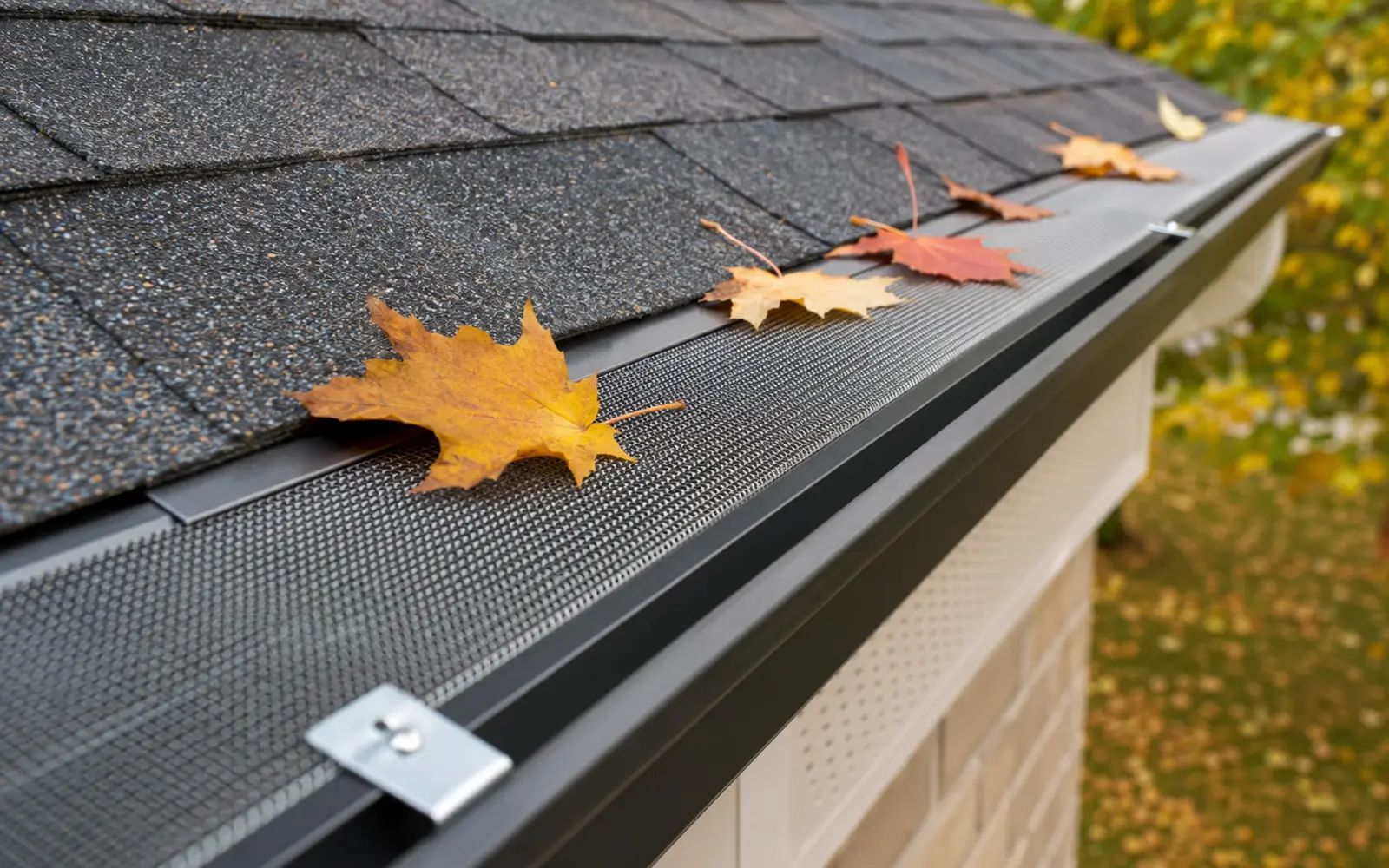
Guard installation begins with the existing system
Covering a damaged or poorly draining gutter will not correct its underlying problem.
Condition Review
Check for sagging, leaks, damaged corners and loose attachment before adding a cover.
Debris Review
Consider whether the property produces broad leaves, needles, seeds or fine roof material.
Compatibility
Match the guard to the gutter profile and existing roof-edge conditions.
Outlet Check
Clear and inspect the points where water enters each downspout.
Installation
Secure the selected protection without creating an incorrect roof-edge transition.
Maintenance Plan
Set realistic expectations for surface debris, inspection and eventual cleaning.
The debris type matters
A wide screen that performs well with large leaves may behave differently around fine needles, seed pods or roof granules. Water arriving quickly from a valley can also behave differently than water spread across a long roof edge.
- Tree species and seasonal debris
- Roof pitch and valley locations
- Existing gutter capacity and alignment
- Outlet and downspout condition
- Snow and ice accumulation
- Safe access for future inspection

Guard expectations
| Claim | Realistic expectation | What still matters |
|---|---|---|
| Blocks leaves | Can reduce larger debris entering | Leaves may remain on top |
| No more cleaning | May reduce cleaning frequency | Inspection is still required |
| Stops all clogs | Can reduce outlet debris | Fine material and ice can still affect flow |
| Fits every gutter | Many systems are compatible | Profile and roof edge must be checked |
Adding leaf protection responsibly
- Inspect gutter
- Identify debris
- Choose compatible guard
- Install protection
- Plan inspection
Avoid “never clean again” promises
Guards can reduce debris entry, but no exterior system should be described as permanently maintenance-free. Leaves can collect on top, fine material can pass through and ice can affect winter performance.
Useful details for an estimate
- Existing or new gutter system
- Main type of recurring debris
- Number of storeys
- Areas that clog most often
- Known leaks or overflow
Gutter guard questions
Do gutter guards eliminate cleaning?
No. They may reduce how much debris enters, but surface debris, fine material and outlets should still be inspected.
Can guards go on existing gutters?
Often, if the gutter is sound, aligned and compatible. Repairs or cleaning may be needed first.
What happens to leaves on top?
Some may dry and move off; others can remain and require removal depending on the guard, roof edge and surrounding trees.
Can guards cause overflow?
Water can overshoot or back up when a guard is incompatible, obstructed or receiving concentrated flow. The roof and gutter layout should be considered.
Are guards useful around pine needles?
Fine debris requires careful product selection and realistic maintenance expectations. No generic guard is ideal for every debris type.
Considering gutter guards?
Tell us about the existing gutter, surrounding trees and the debris that causes the most trouble.